
Causes
- Home
- Causes
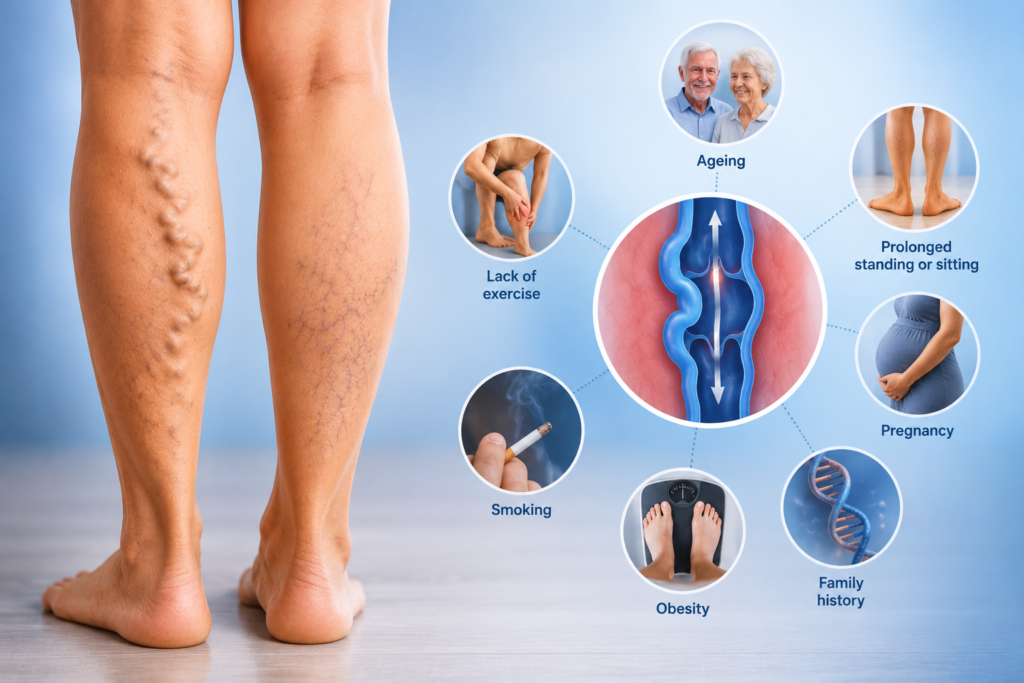
What Causes Varicose Veins?
Varicose veins commonly develop when valves inside the leg veins do not function effectively. These valves normally help blood flow back towards the heart. When they become weakened or damaged, blood can flow backwards and pool in superficial veins, increasing pressure and causing the veins to enlarge, twist or bulge. This is known as venous reflux.
Several factors may increase the likelihood of developing varicose veins, including:
Family history: Having close relatives with varicose veins can increase your likelihood of developing them.
Increasing age: Changes in vein walls and valves over time may contribute to venous reflux.
Pregnancy: Increased blood volume, hormonal changes and pressure on pelvic and leg veins may contribute to varicose veins.
Hormonal factors: Hormonal changes may influence vein function and the likelihood of developing visible veins.
Prolonged standing: Occupations requiring extended periods of standing may contribute to increased pressure in the leg veins.
Excess body weight: Additional pressure on the venous system may be associated with a higher risk of varicose veins.
Previous vein problems: A history of venous disease or previous blood clots may affect venous circulation.
These are risk factors, not guarantees that varicose veins will develop. Some people develop varicose veins without an obvious risk factor.
Understanding these factors can help patients recognise when symptoms may warrant clinical assessment.
Can Varicose Veins Become More Severe Over Time?
Varicose veins do not follow the same progression in every person. Some remain relatively stable, while others may become more prominent or be associated with increasing symptoms.
Possible changes include persistent aching or heaviness, recurrent leg swelling, skin pigmentation, venous eczema and, in more advanced cases of chronic venous disease, skin damage or venous leg ulcers.
Visible vein size alone does not determine the severity of underlying venous disease. Clinical examination and, where appropriate, duplex ultrasound can help identify venous reflux and assess the condition.
Seek prompt medical assessment for worsening skin changes, leg ulcers, bleeding or sudden new swelling. Sudden one-sided leg swelling or calf pain may indicate a blood clot and requires urgent assessment.
Learn more about varicose vein symptoms and when clinical assessment may be appropriate.
Can Varicose Veins Be Prevented?
Varicose veins cannot always be prevented, particularly when risk factors such as family history, ageing, pregnancy or changes in vein function are involved. There is no guaranteed way to stop varicose veins from developing.
However, certain lifestyle measures may help support leg circulation and relieve symptoms such as aching, heaviness or swelling.
These include:
Regular physical activity: Walking and gentle exercise can help support blood circulation in the legs.
Avoiding prolonged sitting or standing: Taking regular movement breaks may reduce discomfort associated with remaining in one position for long periods.
Leg elevation: Raising your legs while resting may help relieve swelling and heaviness.
Maintaining a healthy weight: Weight management, where relevant, may help reduce additional pressure on the leg veins.
Compression stockings: Appropriately fitted compression stockings may help manage symptoms in selected patients when recommended by a clinician.
These measures may improve comfort but do not remove existing varicose veins or guarantee that new ones will not develop.
For further information, explore varicose vein prevention and practical ways to support vein health.
How Are the Causes of Varicose Veins Assessed?
Visible varicose veins may be connected to abnormal veins beneath the skin. Assessment helps identify whether underlying venous reflux is contributing to the condition rather than relying on appearance alone.
A vein assessment generally includes a review of symptoms, medical history, previous vein problems and relevant risk factors. Where clinically indicated, duplex ultrasound may be used to assess blood flow, identify venous reflux and map abnormal veins.
These findings help determine whether monitoring, self-care or treatment options may be appropriate based on individual clinical needs.
Learn more about vascular ultrasound and mapping and its role in assessing venous reflux.
What to Expect at Your First Appointment
First appointments at Vein Care typically run for 30 to 60 minutes. Here is what usually happens:
Step 1 – Clinical history The clinician will ask about your symptoms, how long you have had them, your medical history, any previous vein treatment, and your current medications.
Step 2 – Examination Visible veins are examined with you standing, which is the position that makes varicose veins most apparent.
Step 3 – Duplex ultrasound If clinically indicated and available, duplex ultrasound may be performed during the same appointment. The scan maps the vein anatomy and identifies whether reflux is present and where it originates.
Step 4 – Discussion The clinician explains the findings, outlines suitable treatment options and what each involves, and discusses risks, costs, Medicare eligibility and aftercare.
You are not required to proceed with any treatment at the first appointment. Patients may receive a summary of findings and a proposed treatment plan to consider after assessment.
Vein Assessment at Vein Care Melbourne
Vein Care has been providing specialist vein assessment and treatment throughout Melbourne for more than 25 years, with clinics located in Camberwell, Boronia and Sydenham.
The practice is led by Dr Gurjit Dhillon (M.B.B.S., F.A.C.P.), whose clinical focus is ultrasound-guided assessment and minimally invasive vein treatment.
During your appointment, our team discusses your symptoms, medical history, ultrasound findings, suitable treatment options, expected outcomes, possible temporary effects, fees, Medicare eligibility and follow-up care to help you make an informed decision.
Learn about the varicose vein treatment options available at Vein Care and how treatment suitability is determined.
Address : Suite 307, 685 Burke Road Camberwell VIC 3124
Appointments required.
Please confirm current availability when booking.
Address : 574 Melton Highway
Sydenham VIC 3037
Appointments required.
Please confirm current availability when booking.
Address : 157 Scoresby Road
Boronia VIC 3155
Appointments required.
Please call ahead to confirm current availability.
Consultation and treatment availability may vary between clinic locations. Please confirm available services at your preferred location when booking.
Make an Appointment with Vein Care in Melbourne
To find out more about treating your varicose veins, make an appointment with Vein Care in Melbourne. Call us today on 1300 568 676 or contact us online.
Frequently Asked Questions
Varicose veins commonly develop when valves inside the leg veins become weakened or do not function effectively. This can allow blood to flow backwards and collect in superficial veins, increasing pressure and causing the veins to enlarge, twist or bulge. This process is known as venous reflux.
Family history is an important risk factor for varicose veins. People with close relatives who have varicose veins may be more likely to develop them. However, genetics is not the only factor, and having a family history does not mean you will necessarily develop varicose veins.
Prolonged standing may contribute to increased pressure in the leg veins and can make symptoms such as aching, heaviness or swelling more noticeable. It may be associated with a higher risk of varicose veins, particularly when other risk factors are present.
Taking regular movement breaks may help relieve discomfort.
Pregnancy increases blood volume and causes hormonal changes that can affect vein function. As the uterus grows, it can also increase pressure on veins in the pelvis and legs.
These changes may contribute to the development or worsening of varicose veins. Pregnancy-related varicose veins may improve after birth, although some can persist.
There is no guaranteed way to prevent varicose veins, especially when family history, age or pregnancy-related changes are involved.
Regular walking, avoiding prolonged periods of inactivity, leg elevation and maintaining a healthy weight may help support circulation and manage symptoms. Compression stockings may also help selected patients when recommended by a clinician, but these measures do not guarantee prevention or remove existing varicose veins