Table of Contents
Reviewed by Dr Dhillon, Vein Care
Written By Vein Care Team, Vein Assessment and Treatment Specialists
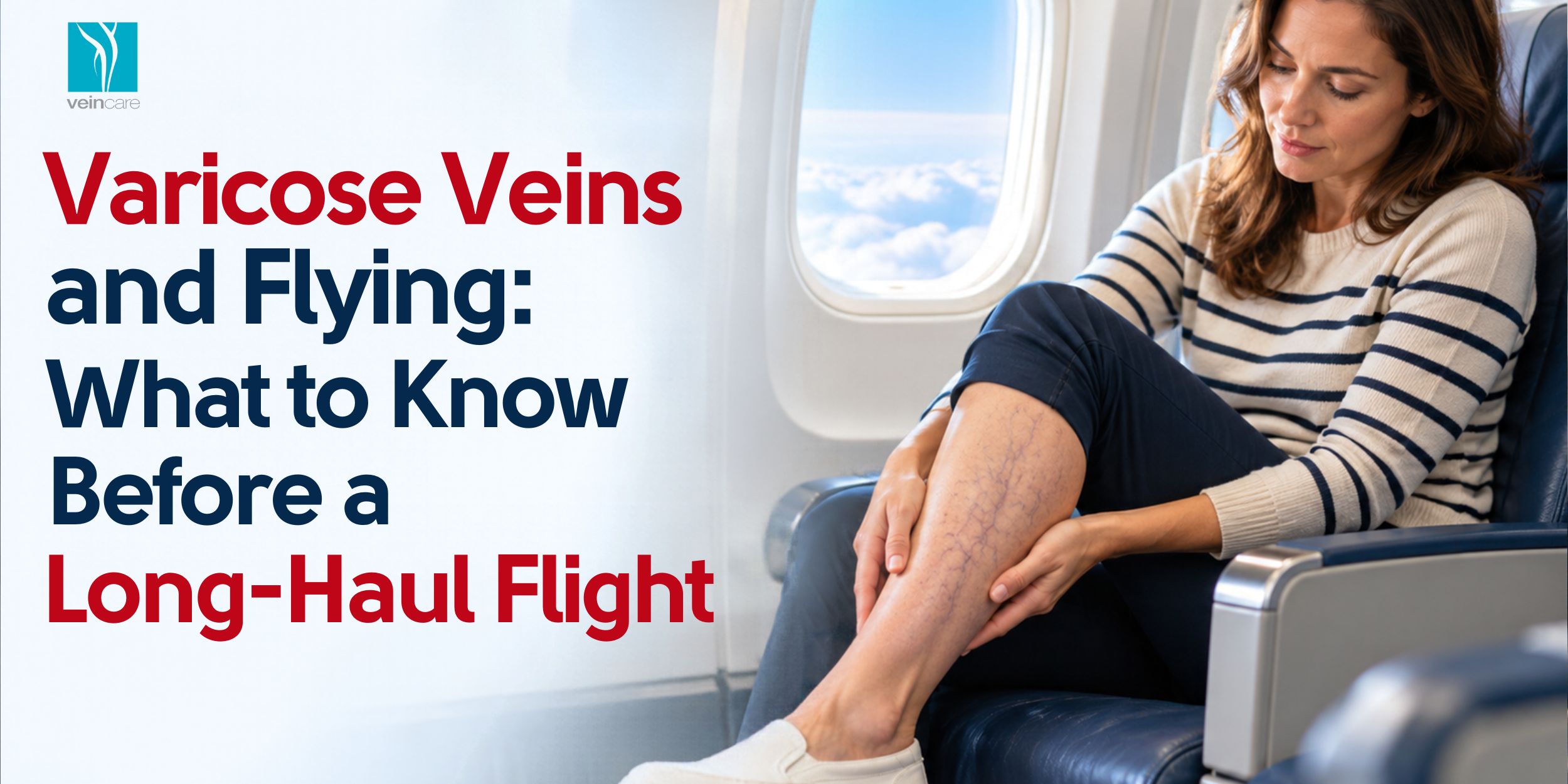
If you’re researching flying with varicose veins before leaving Melbourne for Europe, North America, Asia or another long-distance destination, several hours of sitting can leave your legs tight, swollen or uncomfortable. That doesn’t automatically mean something dangerous is happening.
If you’re weighing varicose veins and flying together, the important distinction is between ordinary travel-related swelling and symptoms that need medical attention.
This article provides general health information and does not replace individual medical advice. If you already have visible veins, recurring leg symptoms, a history of clots or an upcoming vein procedure, your travel plan deserves a little more thought.
Can varicose veins and flying be safe on a long-haul trip?
Yes, most people with varicose veins can fly, including on long-haul journeys. The main concern is prolonged immobility, which can worsen leg swelling and may increase blood-clot risk when other risk factors are present for some people.
Varicose veins on long flights do not automatically mean you need to cancel a holiday or business trip. The more useful question is how long you’ll be sitting and whether you have other factors that raise your risk of DVT.
A Practical Flight-Risk Comparison
| Travel Situation | Main Concern | Sensible Approach |
| Under 4 hours, no additional clot risks | Temporary stiffness or swelling | Move your legs regularly and stay comfortable |
| Over 4 hours, varicose veins only | Prolonged immobility and swelling | Move regularly; ask a clinician whether compression is suitable |
| Over 4 hours plus previous DVT, recent surgery/injury or limited mobility | Higher clot risk | Discuss your travel plan with your doctor before departure |
| Recent vein procedure plus long-haul flight | Recovery and clot-risk considerations | Ask the treating clinician for procedure-specific travel advice |
This table is a guide, not a personal risk assessment. A previous DVT, recent operation, active cancer, pregnancy, limited mobility or other clotting risks can change the advice.
For Australian travellers, the Better Health Channel identifies journeys longer than four hours as a temporary DVT risk factor and recommends movement, leg exercises, loose clothing and discussion with a doctor when risk factors are present.
Why can long flights make varicose veins feel worse?
Long-haul flights and varicose veins can be an uncomfortable combination because you may sit with your legs down and move less for several hours. Reduced calf-muscle activity slows venous return, allowing blood and fluid to pool around the lower legs.
Your calf muscles act as a natural pump, which is central to blood circulation during flights and other long periods of sitting. Each time you walk or flex the ankle, muscle contractions help move blood through the leg veins.
That can explain why someone who feels fine before boarding may notice tight shoes, ankle swelling, aching or a heavy sensation by the end of a long flight.
The effect isn’t unique to planes. A long car journey, train trip or period of sitting at an airport can create the same basic problem: less movement for a prolonged period.
What About Cabin Pressure?
Cabin pressure is often blamed for circulation problems, but it’s better not to treat it as the whole explanation. Current travel guidance places strong emphasis on prolonged limited movement and individual clotting risk.
The practical response is therefore to keep your legs moving and assess your personal risk before travel.
What can you do before and during a long flight?
For most travellers, the useful routine is simple: plan for movement, avoid staying in one position for hours, and get individual advice if you have additional clotting risks or significant vein symptoms before departure for your trip.
- Choose an aisle seat when practical: easier access makes it simpler to stand and walk without waiting for other passengers.
- Move your ankles and calves every 30–60 minutes while awake: heel raises, toe raises and ankle flexion keep the calf muscles active when you can’t walk.
- Stand and walk every 1–2 hours when safe: regular movement reduces the amount of time you spend completely still.
- Wear loose, comfortable clothing: avoid clothing that restricts movement around your waist, thighs or legs.
- Drink water regularly and limit alcohol: water is a sensible choice during a long journey, while relying on alcohol or excessive drinking is unhelpful when you need to stay comfortable and mobile.
- Discuss compression before departure if you have added risk factors: properly fitted graduated compression may be useful for some higher-risk travellers, but it isn’t a universal requirement.
- Do not start aspirin or blood-thinning medication just for a flight without medical advice: prevention medicines are an individual clinical decision and should not be self-prescribed.
For someone leaving Melbourne for a 12–14-hour international flight, the goal isn’t to perform an elaborate exercise routine. It’s to avoid several uninterrupted hours in the same seated position.
Should you wear compression stockings when flying with varicose veins?
Compression stockings can help some travellers, but they are not automatically required simply because you have varicose veins. If you have additional clotting risks or significant swelling, ask your doctor whether properly fitted graduated compression is appropriate for your flight.
Compression works by applying pressure to the lower leg, with graduated stockings generally providing more pressure at the ankle and less higher up the leg. The aim is to support venous return and reduce dependent swelling.
The important point is fit. A stocking that is too tight, incorrectly sized or unsuitable for your circulation problem is not a better stocking.
The CDC Yellow Book recommends properly fitted graduated compression stockings for some long-distance travellers at increased risk of VTE, while people without additional risk factors do not necessarily need medical compression simply because a flight is long.
If you already use compression for your vein symptoms, take the advice you were given by your clinician rather than changing the compression level yourself for a trip.
How are varicose veins and DVT different during air travel?
Varicose veins are enlarged superficial veins, while deep vein thrombosis (DVT) is a clot in a deeper vein. They are different conditions, although varicose veins can be one factor associated with DVT risk during prolonged travel.
Varicose veins commonly cause visible bulging or twisted veins, aching, heaviness, itching, swelling or skin changes. DVT can cause swelling, pain or tenderness, warmth and redness or colour change, usually affecting one leg.
Warning Signs During or After a Flight
A new symptom should not automatically be blamed on your existing veins.
- Sudden swelling in one leg: seek prompt medical assessment.
- Unexplained calf or thigh pain, warmth or redness: seek prompt medical assessment, particularly after prolonged travel.
- Chest pain or difficulty breathing: call Triple Zero (000) for emergency help.
- Coughing up blood, fainting or severe breathlessness: treat this as an emergency and call Triple Zero (000).
Healthdirect advises urgent medical attention for possible DVT symptoms and emergency help when symptoms suggest a pulmonary embolism.
When should you speak with a doctor before flying?
Speak with a doctor before flying if you have had a previous DVT, recent major surgery or injury, active cancer, limited mobility, pregnancy or other clotting risks. If your veins are newly painful, swollen or inflamed, get assessed rather than simply boarding.
It’s especially sensible to ask before a long-haul flight if several risk factors occur together. Your clinician can consider your medical history, current medicines, previous clotting events and the length of the journey.
If you’re unsure whether your leg symptoms are simply varicose-vein discomfort, assessment is more useful than guessing. Symptoms such as persistent heaviness, swelling, aching or skin changes can have several possible causes.
For Melbourne patients, Vein Care’s published approach is to start with clinical history and examination and use duplex ultrasound where appropriate to assess blood flow, map veins and look for venous reflux.
What should you do after a long flight?
After a long flight, walking and normal movement can help your legs settle, while persistent or unusual symptoms should not be written off as travel fatigue. If discomfort does not improve or feels different from your usual vein symptoms, arrange medical advice.
A practical post-flight routine is:
- Walk gently once you are able and it is safe.
- Avoid sitting still for another long period immediately after arrival.
- Elevate your legs while resting if they feel swollen or heavy.
- Note whether symptoms affect one leg or both.
- Keep a record of when symptoms started and whether they improve with movement or rest.
The risk of travel-associated VTE is generally low for people without risk factors, but the combination of long-distance travel and individual risk factors matters more than the flight alone.
What if you have vein treatment planned around your trip?
Travel restrictions after vein treatment vary by procedure, journey length and clotting risk. If varicose veins and flying overlap with a treatment plan, tell your clinician about the trip before treatment is scheduled because recovery and follow-up can affect a safe plan.
This matters because recovery and follow-up can be part of the travel decision. For example, after some procedures you may need compression, walking, a review or an ultrasound at a particular stage of recovery.
Vein Care’s sclerotherapy aftercare guidance specifically recommends discussing upcoming flights or long journeys before treatment because travel advice can differ between procedures, including foam sclerotherapy and microsclerotherapy.
If your trip is already booked, give the clinic the flight date, total travel time and whether you have connecting flights. That allows the treating clinician to consider the whole journey rather than just the first flight.
What does a pre-flight vein assessment involve?
A pre-flight vein assessment usually combines your symptom history, medical history and physical examination with duplex ultrasound when clinically appropriate. The purpose is to identify whether venous reflux or another vein problem could be contributing to your symptoms and travel discomfort.
At Vein Care, the assessment process can include:
- Review your symptoms and travel plans: note heaviness, aching, swelling, visible veins, previous DVT, previous treatment and the timing of your flight.
- Examine your legs: the clinician can look for visible veins, swelling, tenderness and skin changes.
- Use duplex ultrasound when indicated: ultrasound can assess blood flow, map veins and identify reflux beneath the skin.
- Discuss the next step: depending on the findings, that may be reassurance, self-care, monitoring, further investigation or treatment.
This approach is useful because a visible vein does not always tell the whole story. Vein Care’s published treatment information notes that a deeper abnormal vein can sometimes feed a visible surface vein, which is why assessment may be more useful than judging appearance alone.
When is professional advice worth it, and what might assessment cost?
Professional advice is worth considering when leg symptoms are persistent, worsening, associated with visible vein changes, or occurring alongside personal risk factors for DVT. Assessment can clarify whether you need reassurance, further investigation or treatment before travel.
Vein Care’s published cost information has previously listed an initial assessment at approximately 150–300. Current fees should be confirmed directly with the clinic because the consultation, ultrasound and later treatment requirements can vary.
The exact cost can depend on whether ultrasound is needed, the type of consultation and any later treatment. Medicare benefits may apply to eligible medical services when current requirements are met; cosmetic treatment is generally treated differently.
For someone planning a long-haul trip, the value of assessment is not simply deciding whether you can fly. It can clarify whether your symptoms need treatment, whether compression is appropriate, and whether your itinerary should influence treatment timing.
Long-Haul Flight Checklist
| When | What to Do | Why It Matters |
| Before booking | Consider flight length and personal DVT risks | Travel advice depends on more than varicose veins alone |
| 1–4 weeks before, if higher risk | Ask your doctor or treating clinician for individual advice | Some risks and procedures need advance planning |
| Before boarding | Have comfortable clothing and any advised compression ready | Makes movement easier and supports your planned routine |
| Every 30–60 minutes while seated | Flex ankles, raise heels or toes and move your legs | Keeps the calf muscles active |
| Every 1–2 hours when safe | Stand and walk | Breaks up prolonged immobility |
| After landing | Walk gently and avoid another long period of sitting | Helps you return to normal movement |
| After travel | Watch for unusual symptoms and seek appropriate care | Some post-travel symptoms require medical assessment |
Conclusion
Varicose veins and flying are not automatically a reason to cancel a long-haul trip. The key is to reduce prolonged immobility, understand your personal clotting risks and know which symptoms need prompt attention.
If you have ongoing vein symptoms or a flight planned around treatment, a personalised assessment can help you make a safer, better-informed travel plan. For local treatment information, explore varicose vein treatment Melbourne options through Vein Care and discuss whether further investigation or treatment is appropriate.
FAQ'S
Can I sleep on a long flight if I have varicose veins?
Yes, you can sleep, but avoid spending the entire flight in one position. If you’re taking a long-haul journey, set yourself up to change position and move your ankles when awake, and get up when safe. If your doctor has given you specific travel instructions, follow those rather than relying on general advice.
Can varicose veins get permanently worse after a long flight?
No, a single long flight does not mean your varicose veins will permanently worsen. Temporary swelling or aching can occur after prolonged sitting. If a vein becomes newly painful, swollen, red, warm or noticeably different after travel, arrange medical assessment rather than assuming it is ordinary post-flight discomfort.
Can a short flight still cause a blood clot?
Yes, although the risk is generally much lower on shorter journeys than on long-distance travel. Your overall risk depends on the duration of immobility and personal factors such as previous DVT, recent surgery, cancer, pregnancy or limited mobility. Seek medical advice if you have significant risk factors.
Should I take aspirin before a flight to prevent DVT?
No, do not take aspirin specifically to prevent a travel-related blood clot unless a clinician has advised it for another medical reason. Travel-prevention decisions depend on your individual risk. CDC guidance does not recommend aspirin as routine DVT prevention for travellers.
How long after a flight can DVT symptoms appear?
DVT symptoms can occur during travel or after you arrive home. The important point is to respond to the symptom, not wait for a particular number of days. New one-sided swelling, unexplained pain or tenderness, warmth or redness should be assessed promptly, especially after a long journey.
Can I travel by car or train if I have varicose veins?
Yes, the same basic circulation issue applies to long car and train journeys because prolonged sitting limits movement. Plan regular stops or walking breaks, move your ankles while seated and follow any individual compression or medication advice. If you have additional clotting risks, discuss the journey with your doctor beforehand.